Math finance program celebrates 20th anniversary with Nobel laureate visit

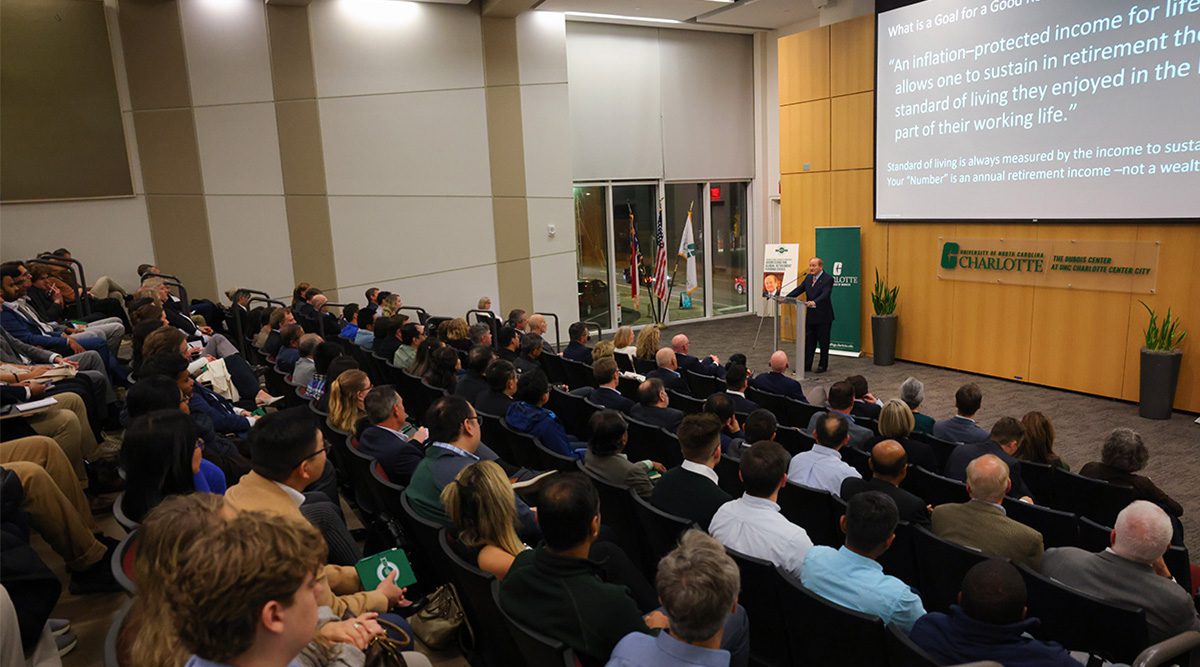
It was a full-circle moment for UNC Charlotte alumni on Nov. 14 at a celebration of the 20th anniversary of the nationally ranked Mathematical Finance program.
Among alumni attending were members of the first graduating class, along with students, faculty, University leaders, staff and Charlotte business executives. Some alumni flew or drove in from other states and Carolinas cities to show their support.
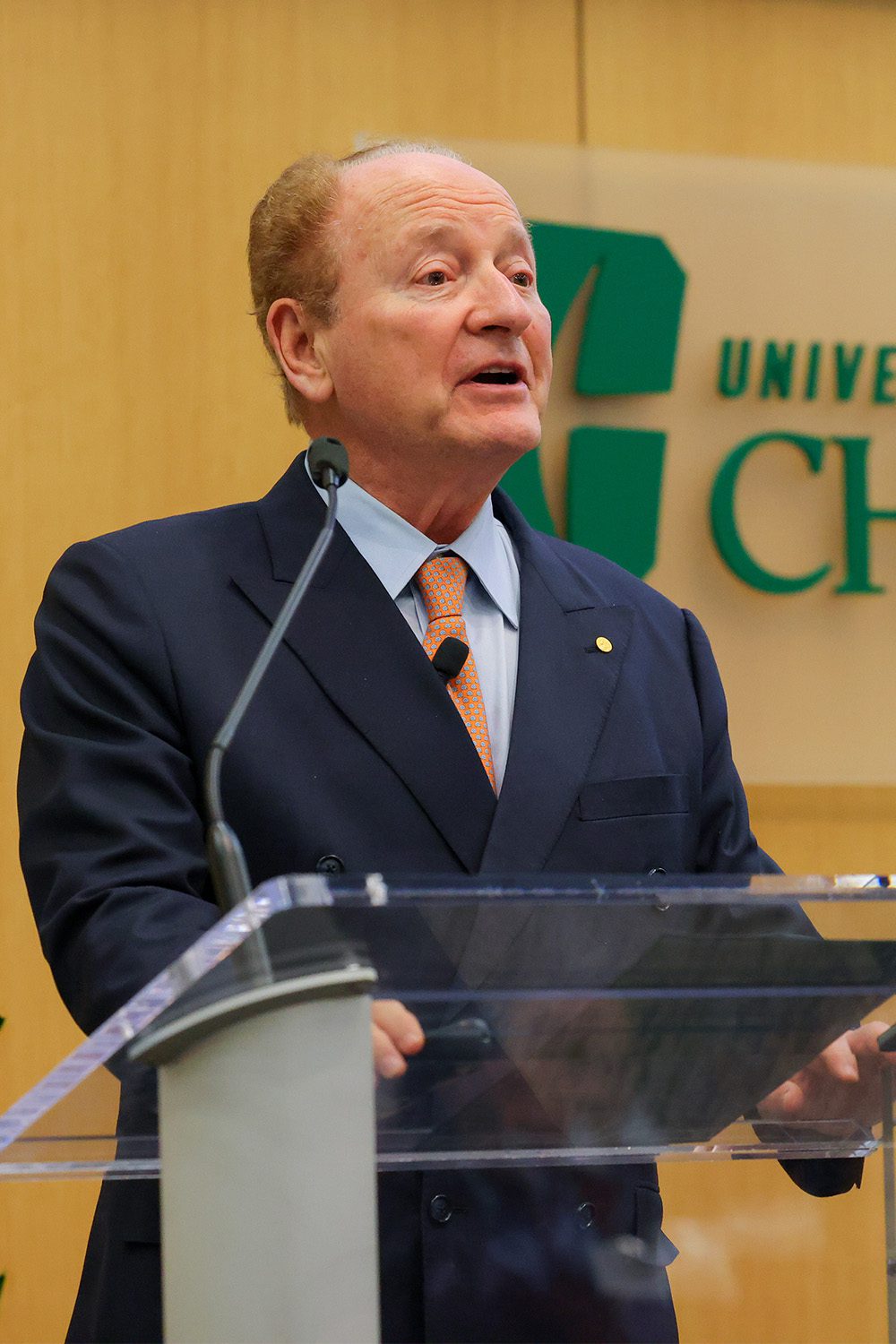
To mark the occasion, Nobel laureate Robert C. Merton joined the Charlotte crowd to explore new concepts for solving the global retirement crisis. His talk continued the math finance program’s tradition of relating research to real-world challenges.
“I want to commend the remarkable achievement of the Mathematical Finance program,” Merton told the audience of 225+ at The Dubois Center at UNC Charlotte Center City. “I say remarkable not lightly. Establishing in less than one-quarter of a century the rankings, the development and the support that you have in this program may look easy to those who don’t know, but it’s a very difficult thing to do from scratch. You should take great pride and pleasure in this.”

The program was born two decades ago with support particularly from Bank of America and Wachovia, which later integrated into Wells Fargo. Cultivating corporate involvement and adapting curriculum to emerging needs have been essential to ensuring the program delivers the talent Charlotte needs, said Belk College of Business Dean Richard Buttimer.
“Our program’s interdisciplinary core has been critical to its versatility and its responsiveness,” Buttimer said. “The collective knowledge we have in economics, finance and mathematics and statistics in the Belk College and in the Klein College of Science continues to prepare our graduates to thrive in the rapidly evolving quantitative world.”
The emphasis of the two colleges on excellence in academics, research and engagement with employers has advanced the vitality of the Charlotte region, particularly in the nation’s second largest financial and banking center.
“The Klein College of Science and our Mathematics and Statistics Department are focused on shaping the future of scientific discovery,” said college Founding Dean Bernadette Donovan-Merkert. “We cultivate a spirit of inquiry that our graduates take into their careers, many of them in Charlotte.”
Attendees at the celebration tapped into their own spirits of inquiry, as Merton — a founder of modern finance and risk management — discussed a growing global and local challenge. Households today hold greater responsibility than in the past for decisions about retirement funding and associated risks. Yet, they often don’t have the knowledge or tools they need, Merton said. People and organizations need to shift their thinking and their approaches, he said.
Key takeaways
- Redefining retirement goals: Merton defines a good retirement as one with an inflation-protected income for life that sustains the standard of living from the latter part of a person’s working life, measured by income instead of wealth accumulation.
- Reality check: Individuals can improve their retirement outcome, generally speaking, in four primary ways: by saving more, working longer, taking more investment risk and improving the income benefits derived from accumulated assets, such as annuities and reverse mortgages on homes.
- Financial innovation: Merton proposes a new global instrument, the Retirement Security Bond, as a sort of government-issued “pension bond” to address the challenges workers in the informal economy face and to simplify long-term retirement saving.
Merton underscored the need to redefine success in retirement planning, stressing that the common focus on accumulated wealth is fundamentally misplaced. A practical change would be to focus on the income stream during retirement instead. This shift, he suggested, would allow individuals to assess more accurately their retirement readiness.
Merton received the Alfred Nobel Memorial Prize in Economic Sciences in 1997 for a new method to determine the value of derivatives, known as the Black-Scholes-Merton Model. He is Distinguished Professor of Finance at Massachusetts Institute of Technology’s School of Management and the John and Natty McArthur University Professor Emeritus at Harvard University. He is past president of the American Finance Association, a member of the National Academy of Sciences and a Fellow of the American Academy of Arts and Sciences.