Novant Health leader offers students insights into real-world experiences
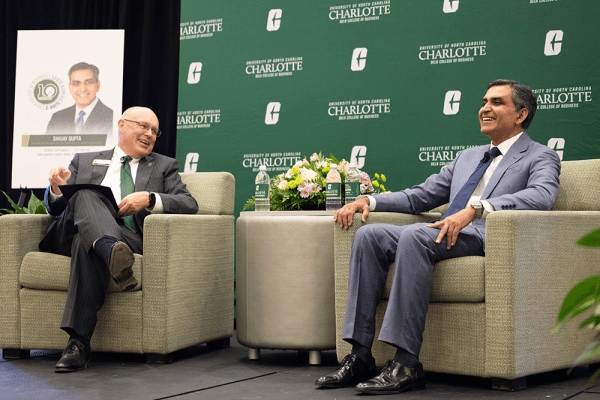
Novant Health C-suite leader Sanjay Gupta, executive vice president and chief transformation officer, gave Charlotte students a firsthand look at how his remarkable career has taken forward steps, sideways moves and even a slight step back — all of which have prepared him for his current role.
Gupta’s career journey offered powerful takeaways at the Belk College of Business C-Suite Series fall session, held at the Popp Martin Student Union and moderated by Dean Richard Buttimer.
Each semester, the college hosts a top business leader to meet with students. In one of the nation’s fastest-growing business hubs, students don’t just hear about leadership in the classroom; they experience it firsthand through direct access to industry leaders.
Gupta’s story is marked by a drive to make a difference and solve real-world problems, propel growth, reduce costs and improve processes. He leads value creation across the health system through patient-centric initiatives and innovative partnerships. Gupta also oversees Novant Health’s strategic operations for integrated care solutions, as well as the organization’s digital transformation and marketing and communications functions.
Learning from the past
Gupta described for students his first professional job, at Federal Express, after he finished an MBA.
“When I got a handle on things after a few months, there just wasn’t enough work to do in my area,” he said. “Meanwhile, there was this forecasting group that was working day and night.”
He offered to not only complete his own duties but to also help out the short-staffed team, which turned out to be a big move for his own learning. “I went from having a narrow point of view to now understanding what the entire company does,” he said.
Later, he took on a role that at first reduced his job title and dropped his pay. Soon enough, however, he jumped ahead in his career, having mastered new skills. He’s never forgotten those early lessons.
Innovating in healthcare
Decades later, after working in financial services, insurance and other sectors, Gupta joined Novant Health, an integrated network of nearly 900 locations, including 19 hospitals, more than 750 physician clinics and urgent care centers, outpatient facilities and imaging and pharmacy services.
He took on the role of chief transformation officer after he became convinced he could make a difference, during a meeting with the president and CEO. “I told him that my physician friends and patients I meet are all talking about the same challenges in healthcare,” Gupta recalled. “It was clear we needed to find a better way forward.”
Gupta’s role is custom-made for advancing improvements. Most recently, he took on leading efforts to leverage artificial intelligence at Novant Health.
In one instance, Novant Health uses AI as a tool to help identify patients with higher risk factors for lung cancer, for example, but who have not yet scheduled a diagnostic scan. “We’re proactively reaching out to those patients to say, ‘Let’s get you in and get you scanned,’ because that’s going to lead to early detection.”
From a business perspective, they use AI to appeal claims that insurance companies deny, rather than the patients struggling to untangle the complicated paperwork themselves.
AI can improve information that patients and their families get about timing of doctor visits in the hospital, which can vary. “One of the things that is a bit of a mystery is when will that physician come around to do their rounds,” Gupta said. “You as a patient would be keen to know that, and your loved one doesn’t have the time to spend just waiting for that physician.”
Responding with AI
In emergency departments, where every second counts, AI can help medical teams triage patients by identifying those at risk of serious conditions like stroke or pulmonary embolism, even before a physician can make the call. As Gupta emphasized, “Minutes matter when you’re facing a stroke.”
For rural communities that can’t afford a dedicated neurosurgeon, virtual capabilities powered by technology are allowing specialists to be available to local hospitals today. An AI-enabled system also can help by taking notes for doctors, so they can focus better on listening to patients.
More disruptive forces are coming in healthcare, Gupta said. “There is a physician shortage coming,” he said. “There is a nursing shortage coming. So that is something that we need to be aware of. The other issue we have is we are going to see some financial headwinds because healthcare systems are going to see their volumes compressed because costs are going up, and reimbursement rates are coming down.”
Gupta advises his team to be creative and pursue their ideas. “I’m not trying to say that there’s a shortcut to the hard work you need to do,” he said. “The point is, you should be enthusiastic about the opportunity.”
Offering powerful advice
Gupta’s advice for students was straightforward and powerful. “What you bring is a fresh perspective because you have the ability to say, ‘Why does it work this way?’ And that is really important because a lot of times things are done because they’ve always been done that way and no one has questioned why it should be done that way,” he said.
Beyond that, young professionals should cultivate a good attitude, because people want to work with people with positive approaches, he said. “You should also have an attitude of being a voracious learner,” he said.
Through his remarks at the C-Suite Series, Gupta made it clear that Charlotte students’ fresh ideas, hard work and real-world insights are what healthcare needs, especially in a dynamic city like Charlotte.