Communities must build resilience to survive economic shocks, Charlotte and Irish experts say

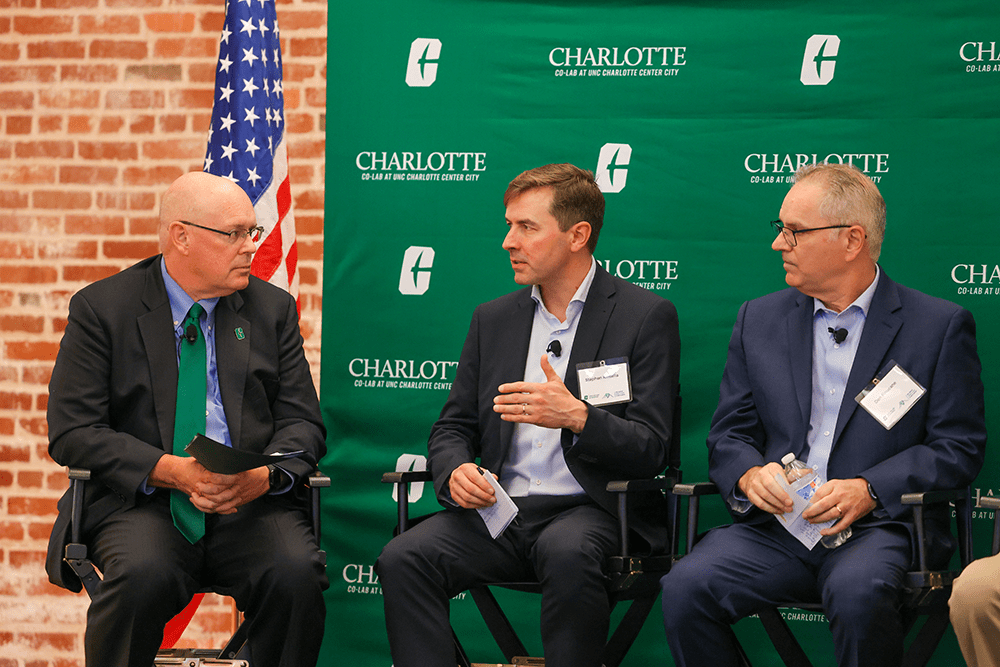
Pandemics, financial crises, policy shifts and other economic shocks can rattle even the strongest economies, but a focus on resilience can soften the blow. This is a key takeaway from a “Strengthening Economic Resilience” panel last week with academic, business and policy experts from the Belk College of Business, the Charlotte region and Ireland.
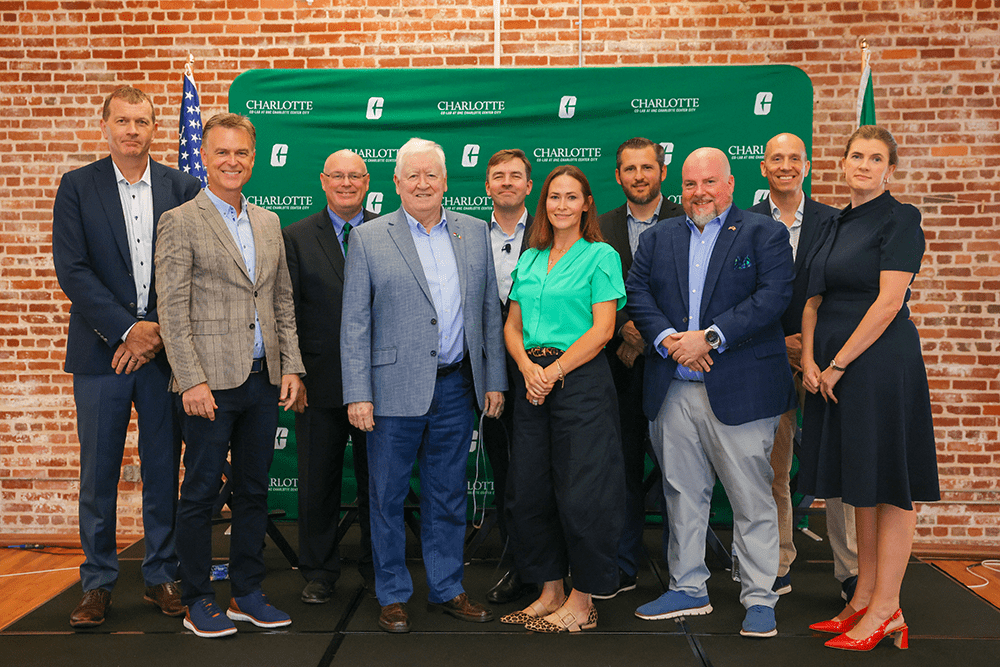
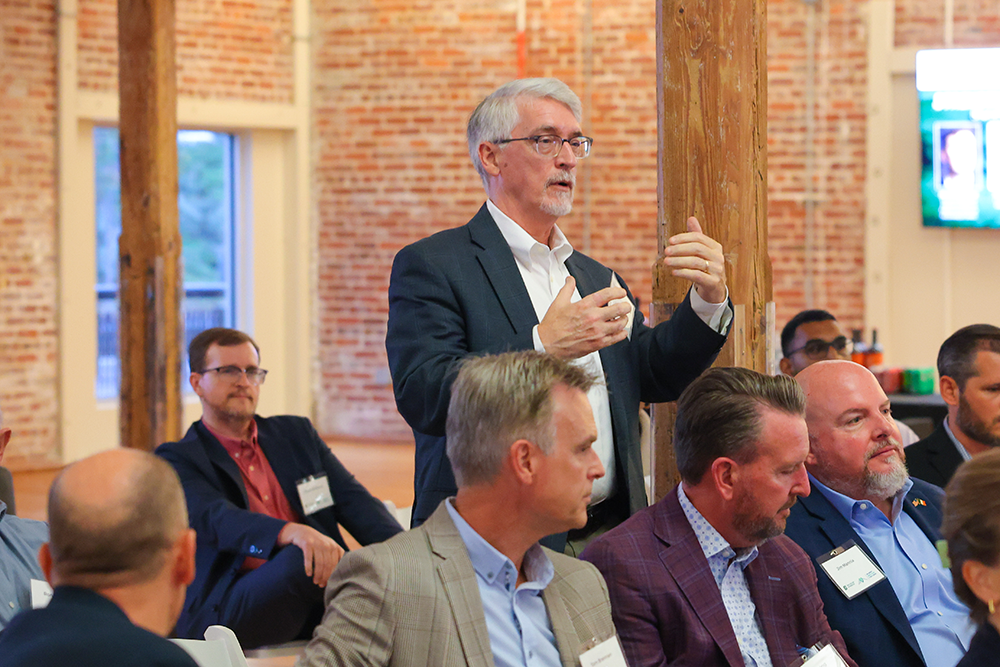
The Belk College and the Irish American Business Alliance of North Carolina hosted the discussion at CO-LAB at UNC Charlotte Center City, the academic and research partner for the North Tryon Tech Hub.
Observations from the experts were consistent.
- Plan now for the next disruption, with a focus on endurance.
- Diversify, so that more than one business sector can define the future.
- Invest for the future, through talent development and capital strategies.
- Face challenges together.
Panelists revealed similarities among North Carolina, the Charlotte region and Ireland and discussed the importance of Ireland and the state’s trade relationship. Ireland is the largest importer to North Carolina, mostly due to pharmaceuticals. In one significant aspect, Ireland supplies active pharmaceutical ingredients for many of the pharma plants being built in North Carolina, including in the Charlotte region.
Endurance proves key
Since 2008, Ireland has successfully managed crises that have included an economic bailout, austerity, Brexit, the COVID-19 pandemic and the cost-of-living crisis. Now, the country has full employment and a budget surplus.
“Resilience is the ability to cope with the shock and emerge a bit stronger, especially if you can make sure that the people who are most exposed to the shock are taken care of,” said Stephen Kinsella, who is head of the Department of Economics at University of Limerick, a public research university in Ireland, and advisor to the highest level officers in the Irish government.
“In an Irish context, the first and most important thing is to endure,” Kinsella said. “It depends on the crisis, but in general, if you’re in a situation where you’re solving the problem together, you’re normally in good shape.”
Economic diversification adds strength
In the Charlotte region and the Carolinas, as in Ireland, forging resilience requires a focus on industrial and economic diversity, panelists said.
“We’re sitting in Charlotte, this robust, thriving city that’s growing remarkably quickly,” said Matthew Martin, Federal Reserve Bank of Richmond regional executive. “You can look around, and we still have manufacturing here. We’ve got banking. We’ve got lots of other corporate entities located here. It’s a pretty diverse economy. Now, we found out during the Great Recession, it was a little banking heavier than some, and that hurt us more than some other places.”
Since then, the region has worked to expand clusters in addition to the financial sector, with 157 people on average moving to the region every day.
In Ireland, reliance on one economic sector led to a shock in the mid-2000s, Kinsella said. “It was basically about property development, buying houses, using money we borrowed off Germans and selling property to each other, which is not a great business model,” he said.
The initial failure of Ireland’s economy in 2008 stemmed from a housing bubble that collapsed and a highly exposed banking system from lending practices, fiscal policies and international borrowing. The global financial crisis added more stress, as did a painful bailout. Since then, Ireland has transformed from a monoline economy to one that has broader range, including investment in information and communication technology and life sciences sectors, along with food and tourism.
Recovery varies
In some communities, people have found ways to transform jobs and grow skills when a major shock has occurred, shifting employment toward higher paid roles, often driven by private sector dynamism.
Panelists described two such transformations. One was when Dell closed a large manufacturing facility in Limerick in Ireland and displaced thousands of workers. The second was in Kannapolis, where the closing of Cannon Mills in the early 2000s caused the largest one-day layoff in North Carolina history. In both cases, structural changes later shifted the economy’s reliance from one sector to more varied and higher-growth sectors.
Yet, outside the Carolinas’ major population centers, communities still are recovering from the North American Free Trade Agreement, Martin said. “In Scotland County, in the years following NAFTA, they lost three key employers, and employment has not recovered,” he said. “You can talk about a globalized economy that benefits people overall, but there are still these economies that struggle.”


Policy decisions matter
In other policy discussion, panelists recalled the approaches that the United States and Ireland governments have taken during periods of economic stress.
During the pandemic, the federal government in the United States provided stimulus funding directly to households. “The U.S. recovered economically much faster because of that, but (now) we do not have a (federal) surplus like Ireland does,” Martin said. “I think the next time we go through something like that, we won’t have that same flexibility.”
In Ireland, the success of the multinational sector means that corporate tax revenue is based on a relatively limited number of companies. “If anything, it’s so diversified, it’s so international, and the multinational sector is so dominant in the economy, its success almost poses a risk,” Kinsella said. “But as I tell everybody in government, there are upside risks and downside risks, and we need to manage both. And we do, but diversification has become a big part of what we do.”
Infrastructure creates advantages
The presence of major transportation assets contributes to resiliency, said Craig Depken, chair of the Department of Economics in the Belk College. In the Charlotte region, transportation’s significance is clear, with sprawling distribution centers for Amazon, Chewy, Macy’s, FedEx, UPS and others. Drawing a circle around Charlotte, four or five states are within a few hours’ drive time, Depken noted.
“Coupled with the airport here and the airport in Cabarrus County, that transportation network serves us very well,” he said. “During the peak of COVID, cities and counties with an interstate going through were still thriving, partly because trucks were moving.”
Talent adds strength
Shocks drive home the need for workers to be agile and flexible. The focus at the Belk College, now the largest public business school in the state, is on teaching such universal skills as critical thinking, problem-solving, effective communication and ethical behavior.
Faculty and staff at Charlotte work with students to enhance their individual adaptability, said Department of Management lecturer and Doctorate of Business Administration scholar Donald Finucane, who applies his 30 years of corporate executive experience to prepare students for leadership roles.
“We’ve got a lot of students that have significant work and family commitments,” Finucane said. “And yet they are showing up. And this is the same cohort that was in high school for COVID. So, they had a lot to deal with, but they’re already got a really solid foundation of resilience, in my view. And it’s on us to build on that foundation.”
Finucane and other faculty offer students opportunities to work on collaborative projects and invite business leaders from the community to class to bring real-world learning to life. Students are drawn to the University in part because of its strong connections to the Charlotte region, with about 40% of its students being first-generation college attendees.
Belk College has a high percentage of undergraduate students who will have completed a formal internship by the time they graduate, said Belk College Dean Richard Buttimer, who moderated the panel. To encourage students to seek real-world learning, the college has created the Gold Standard, which rewards scholars for taking a proactive approach to obtain at least three high-impact experiences.
Employers need the engagement of the University and the college in responding to their needs, Martin said. “I view North Carolina as largely a two-cylinder economy, the Charlotte area and the Raleigh area,” he said. “And what keeps that two-cylinder engine running is college graduates filling jobs. Charlotte’s doing a great job of growing and trying to fill as many of those here as possible.”
Collaboration counts
Collaboration is one of the most powerful elements of economic resiliency, the experts agreed. North Carolina and Ireland share a cultural trait of modesty, which fosters collaboration, Finucane observed. In the academic world, collaboration allows for the sharing of ideas and data for important research.
Partnerships work best when the incentives for academia, business and government are aligned, and when people and organizations take time and effort to build relationships. “It’s tricky to do it, but if you can align incentives, you can move things forward at incredible speed,” Kinsella said.