Belk College scholar soars with curiosity, drive
Story and photos by Lynn Roberson
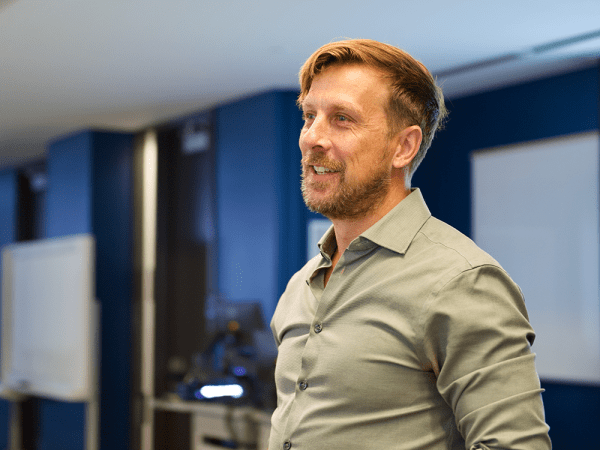
Michael-Paul James is a rare bird, able to fly in the boardroom, the classroom and the shop floor.
He’s worked several “side gigs” — as a mechanic, a professional musician and founder of an entertainment technology design firm. In his spare time, he coaches pickleball, soccer, baseball and dance. He’s also an impressive UNC Charlotte academic, earning four master’s degrees in five years and most recently a doctorate, while teaching and conducting research in the Belk College of Business.
When you peel back the layers of James’ multi-faceted life, you find an insatiable curiosity and an unrelenting drive to help others learn, no matter the subject.
“I’ve been teaching my whole life,” James said. “I don’t just see teaching as a job. It’s part of who I am. It’s not something I turn on and off. Teaching isn’t just my profession. It’s my personality.”
Aleksandra Degernes ’24 MSM first met James when he was a guest speaker in a master of science in management class she was taking. “Within minutes I was hooked — sharp insights, incredible story and a personality you don’t forget,” she said. “Michael-Paul is hands down one of the most fascinating people I’ve ever met.”
As president and CEO of the Eastern European Business Network CLT, Degernes has invited James to share his story and tips for building relationships at one of its networking sessions. She values that every step of his journey has led to his knowledge of how influence, reputation and opportunity work.
Keeping people at the center
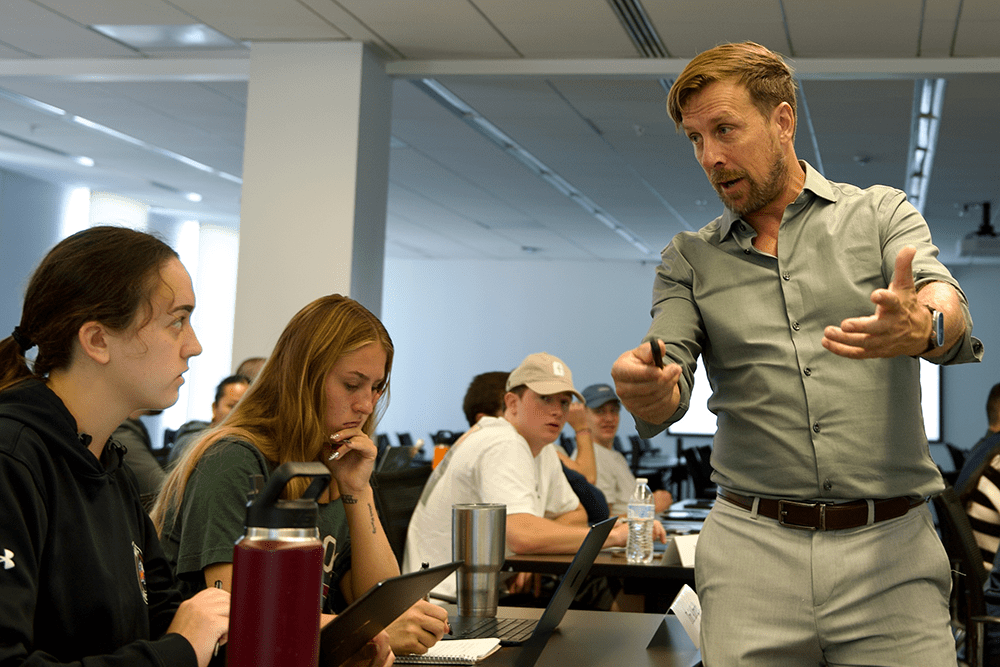
Students quickly sense James’ dedication to their learning. More than 20 graduating seniors have chosen him as a person who has made the most significant positive contribution to their education at UNC Charlotte. He was a finalist this academic year for an Outstanding Graduate Teaching Assistant Award, recognized for innovative, stand-out teaching techniques.
Most recently, as he has pursued a Ph.D. in business administration with a finance concentration in the Belk College, James is instructing students in investments, real estate finance and financial management courses.
Before beginning doctoral studies, James earned an MBA and master’s degrees in architecture, urban design and real estate. He maintained a 4.0 GPA in three of the programs, and close to that perfect score in the fourth. He also completed a graduate certificate in public policy research and analysis.
James credits the Master of Science in Real Estate program and the Childress Klein Center for Real Estate with “unraveling the mystery of financial feasibility” and exposing him to real estate industry leaders who share other real-world insights with students.
“I really enjoy the creative process,” James said. “There are riddles you’re trying to solve and messages you’re trying to unravel.”
Impacting Charlotte through research
Childress Klein Distinguished Professor of Real Estate and Urban Economics Yongqiang Chu, one of James’ mentors, has seen James’ drive — and the impact on Charlotte.
“Michael-Paul has been an excellent master’s degree and doctoral student and a dedicated research partner,” Chu observed. “I find him to be intellectually curious and committed to producing research that will be useful to businesses, policymakers and others. He is equally devoted to ensuring that students in his classes grasp not just published findings but also gain an understanding of how to ask questions and apply knowledge.”
James’ research examines how political identity and behavioral biases shape markets, focusing on housing transactions, asset pricing and analyst forecasts. He is co-author with Chu of a research paper that shows that households aligned with the U.S. president are more likely to buy and sell homes because they feel less uncertainty, which affects prices and market liquidity.
The paper was a semi-finalist for the Best Paper Award at the Financial Management Association Annual Meeting last year and also was a key resource used for an article in The Wall Street Journal.
James also received a 2025 Best Discussant Award from the Financial Management Association International, serving as a bridge between presenters and the audience.
“My goal as a discussant was to help authors strengthen their work, sharpen identification and move promising ideas closer to publication,” he said. “I have always believed that service to the finance profession is one of the best ways we grow as researchers and teachers. Moments like this deepen my commitment to mentoring and collaborating across disciplines in real estate finance, political economy and market behavior.”
Learning how to be a mentor
Mikey Cummings, one of James’ role models, who worked in the event management industry, opened his eyes to different ways of mentoring. “He could do just about everything, but he wasn’t big on explaining it,” James said. “If I asked how to do something, he’d go grab the manual, hand it to me, and walk away. That really pushed me into a DIY mindset. I learned how to figure things out on my own.”
Another significant influence came when he worked at Georgia Pine Straw with business co-owner Clint Williams.
“I watched this business leader work alongside his employees,” James said. “He was the mechanic in the shop, loading pine straw, and working in the fields. He seldom wore a suit, only work clothes, and he wasn’t afraid to get dirty. That example of servant leadership shaped me. He knew every part of his business, and if something broke, he could fix it himself, when his team was better serving some other function. He would always walk briskly with purpose. I imitated his walk working beside him, and continue to walk that way today.”
James hopes to take all he has learned from others and from his academic studies to serve as a role model in the academic finance arena. He sees that as the perfect place for his polymath approach, where he can apply his deep and extensive knowledge and holistic mindset to solve complex problems.
“Academics rarely get the credit,” he said, “but their work produces the kinds of solutions that have lasting effects on how culture functions. I’ve been given a mix of intellectual and creative abilities, and I see it as my responsibility to use them to the fullest. That’s how I believe I can contribute something meaningful.”