A Crisis in Real Time
JL Price MBA students put leadership to the test at Charlotte Douglas International Airport
A winter storm was bearing down on Charlotte Douglas International Airport on the Friday of a holiday weekend. Inside the terminal, a gas-line problem was creating concerns for travelers, affecting heating and preventing restaurants from preparing hot food.
Then the scenario escalated. The terminal was approaching its legal capacity. A physical altercation broke out, drawing a police response and media attention. Confusion spread through security checkpoint lines.
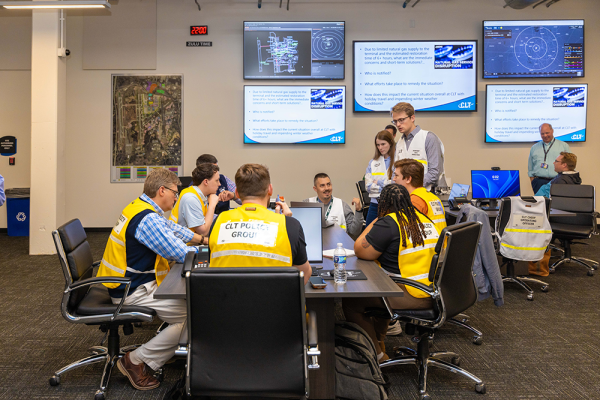
Fortunately, this chaotic event wasn’t real but a three-hour tabletop exercise that was the culmination of Managing Complex Organizations: Lessons from Charlotte Douglas International Airport, a special-topics MBA course developed with University and airport leadership. In the exercise, 13 students in the JL Price MBA program faced decisions designed to reflect the complexity of leading one of the world’s busiest airports.
Coordinating across complexity
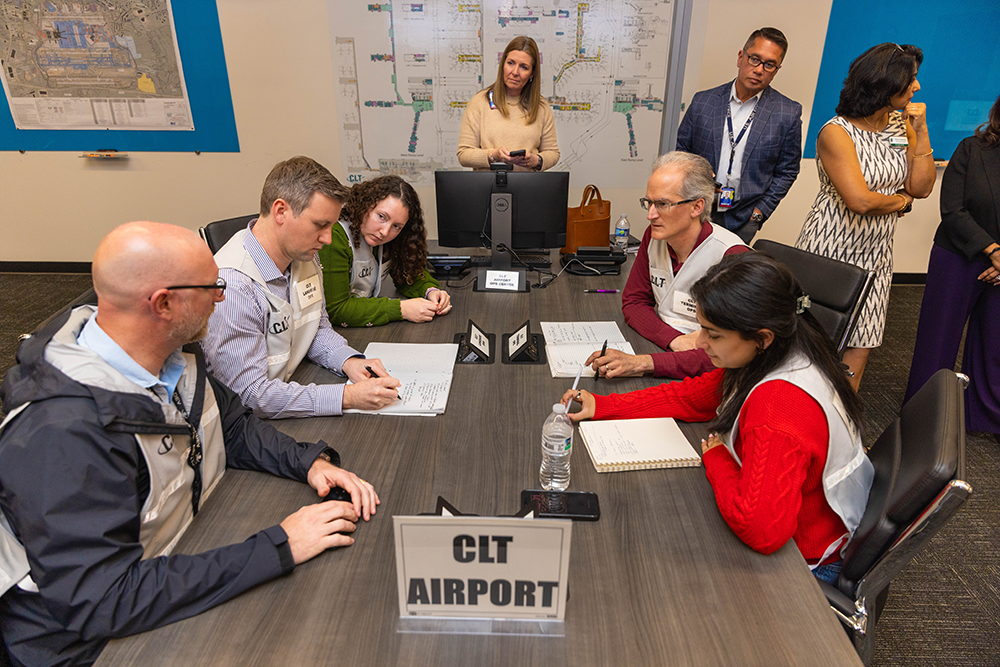
Inside the Airport Emergency Operations Center, students worked in three teams: Operations, Finance and Administration and Policy.
Each team approached the evolving crisis from a different perspective. But they were also expected to move beyond their assigned roles, communicate across teams and consider how their decisions would affect the airport as a whole.
As new complications were introduced, students had to continually reassess their response: How could the airport restore order at security checkpoints and move passengers efficiently? What should travelers in the terminal be told about the gas odor? How should the airport communicate with the public and news media? What additional employees were needed, and who could approve overtime? How could airport leaders support employees working extended shifts while also providing food and warmth for stranded passengers?
Even after the immediate crisis began to resolve, the work was not finished. Students had to plan how the airport could transition toward normal operations while still managing winter weather and holiday-weekend traffic.
Mark Mulchaey, airport operations director and a co-creator of the course, said students were fully committed to the exercise.
“All students took the role-playing event seriously and tried to play their assigned roles realistically,” Mulchaey said. “They were actively engaged throughout the entire class and committed to working the problem.”
Learning the system before leading through crisis
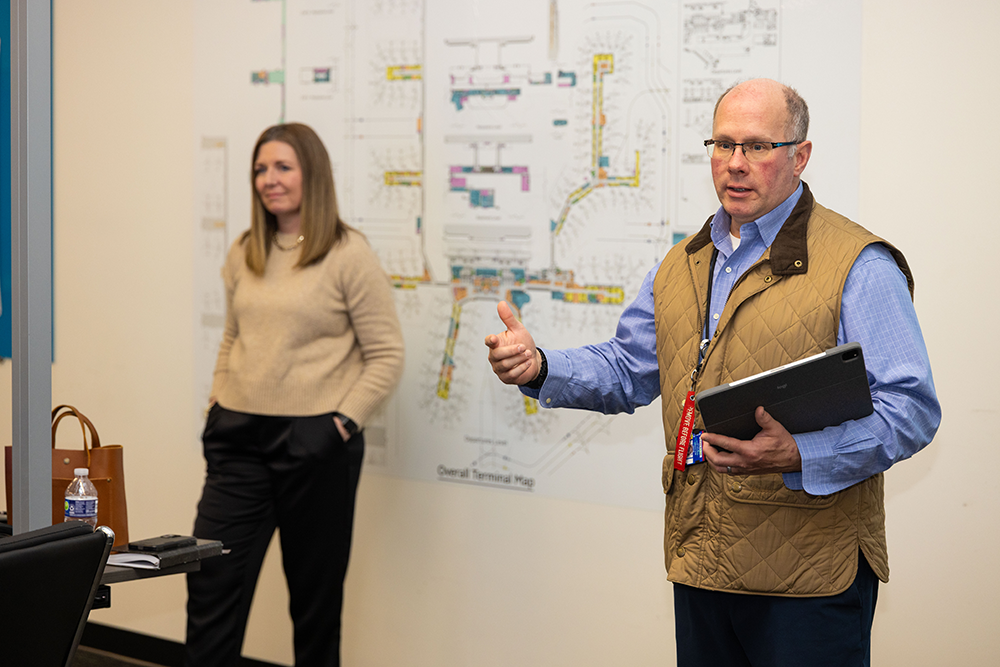
The simulation was not an isolated exercise. It was the culmination of an MBA course intentionally designed to help students understand and lead through complexity. The course grew from a collaboration between Janaki Gooty, co-director of UNC Charlotte’s Center for Leadership Science and then-director of the JL Price MBA program, Tara Cavalline, Director of the Charlotte AIR Institute, and Charlotte Douglas Chief Infrastructure Officer Jack Christine, A.A.E. ‘04 MPA. Gooty then brought in LaShana Wiggs as the instructor, who worked with Christine and airport operations director Mark Mulchaey to build the course structure and learning experience.
Throughout the semester, students learned directly from airport leaders representing operations, emergency management, finance, facilities maintenance, customer experience, government affairs and legal. They studied how a major airport coordinates across complex organizational structures, balances competing stakeholder needs, prepares for emergencies, manages customer experience at scale and plans for infrastructure and environmental demands. Those lessons gave students the context they needed before stepping inside the airport and, ultimately, into the crisis simulation.
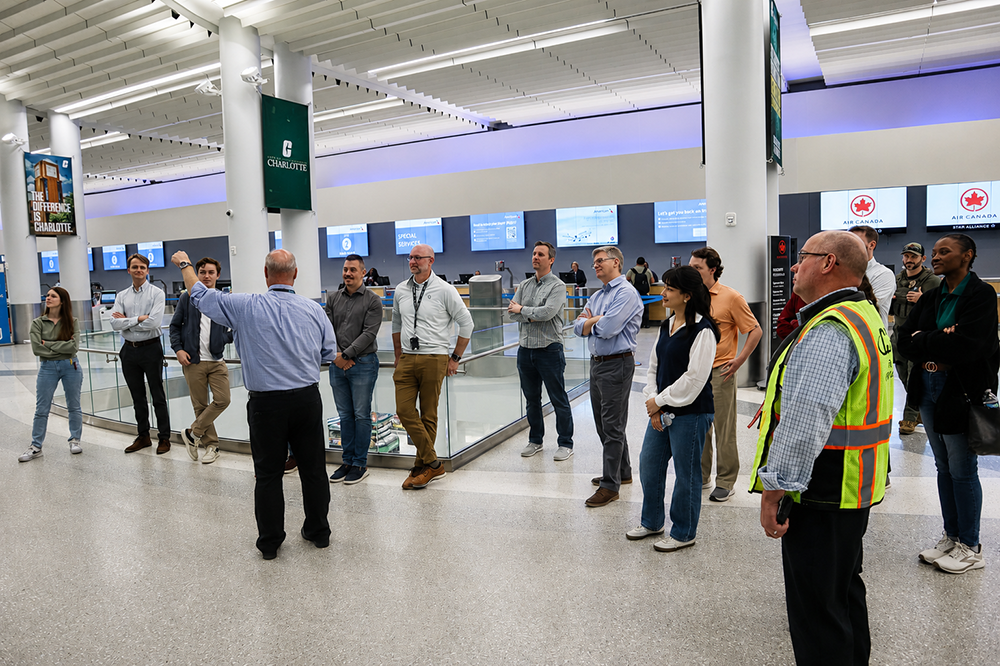
A behind-the-scenes tour gave students an even closer look at the scale and interconnected nature of airport operations. They explored everything from runway expansion and environmental safeguards to ramp operations, terminal design, mechanical systems and the airport’s many customer groups, including passengers, airlines, retailers and rental car companies. The experience gave students a working understanding of how physical infrastructure, business operations and customer experience intersect.
By the time they reached the final simulation, students were expected to do more than understand those functions individually. They had to recognize how decisions in one area could quickly create consequences across the organization.
Airport executives evaluated the students in real time across four areas: risk assessment, adaptive decision-making, stakeholder collaboration and multi-audience communication.
Martha Edge, innovation and experience director at Charlotte Douglas, was impressed by the breadth of issues students identified and worked through during the exercise.
“I was impressed with the issues the team thought to consider and work through,” Edge said. “I wouldn’t expect someone outside of the aviation industry to have this level of airport operations knowledge.”
Learning leadership in a complex organization
The exercise demonstrated that leading through crisis is rarely about solving one problem at a time. At Charlotte Douglas, decisions ripple across operations, staffing, communications, employees, travelers, business partners and public agencies — often all at once.
The course gave students a chance to study those connections inside an organization where complexity is part of everyday leadership. Access to airport leaders was central to that experience.
“I’ve taken many great courses during my MBA, but this one stands out as the most interesting and relevant for me personally,” one student said in the course evaluation. “Having each topic taught by subject matter experts from the airport’s leadership made the learning experience especially engaging and gave us a practical, inside look at how the airport operates.”
For JL Price MBA students, Charlotte can become an extension of the classroom — a place to learn from business leaders, see complex organizations from the inside and put leadership skills into practice.
Industry leaders who contributed to the course
The course drew on the expertise of airport and industry leaders across the semester. The Belk College of Business gratefully acknowledges the time, expertise and insight they shared with our students.
- Michael Hill, Chief Financial Officer
- Eric Hershberger, Airport Finance Director
- Joseph Conklin, A.A.E., Airport Operations Director, Regulatory Compliance
- Kevin Wu, A.A.E., Airport Operations Director, Emergency Services
- Brendan Washburn, A.A.E., Terminal Operations Manager
- Scott Kincaid, Airport Facilities Director
- Martha Edge, Innovation and Experience Director
- Stuart Hair ‘06 MA, Assistant Airport Director, Commercial and Community Engagement
- Ashton Watson ‘06, ‘09 MSCE, Engineering Director
- Jennifer Williams ‘06, Planning Director
- Nate White, Budget and Financial Services Manager
- Elizabeth Smithers, CLT Lead Counsel
- Ted Kaplan, Chief Business & Innovation Officer
- Katie McCoy, Strategy Director